
Strike rate is one of the most useful statistics in cricket. It shows how quickly a batter scores runs and how frequently a bowler takes wickets. However, the meaning changes depending on whether the statistic refers to batting or bowling.
For batters, a higher strike rate generally means faster scoring. For bowlers, a lower strike rate means they take wickets more frequently.
The importance of batting strike rate changes across Test, ODI and T20 cricket. A score of 60 runs from 40 balls can be valuable in a T20 match, while a batter may need to judge the same scoring pace differently in a long Test innings.
This guide explains both types of strike rate, their formulas, worked examples, format-wise differences and how to interpret the numbers correctly.
What Is Strike Rate in Cricket?
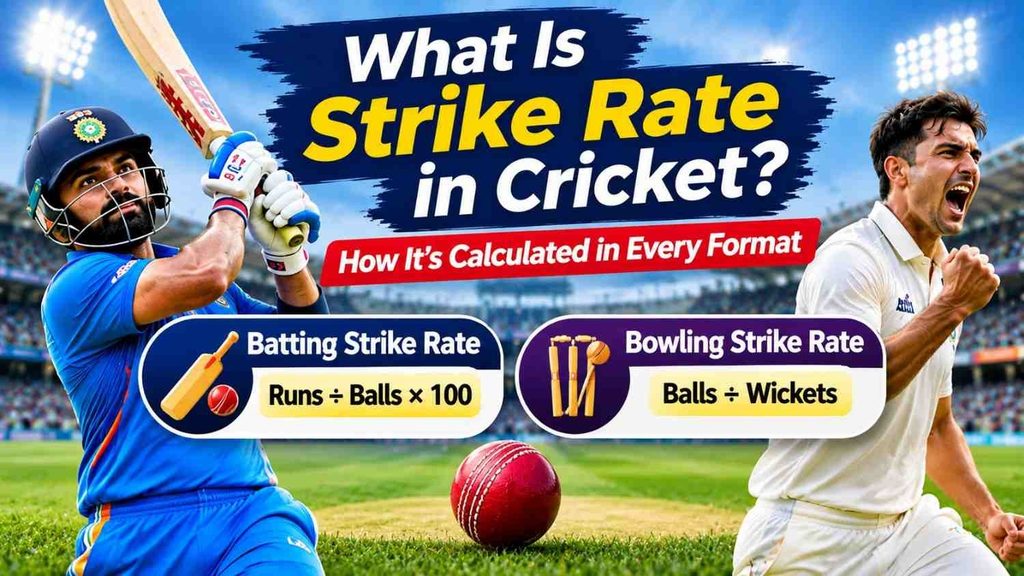
Strike rate in cricket is a statistical measure of scoring speed for a batter or the frequency of taking wickets credited to a bowler. It has two different formulas.
Batting strike rate measures how many runs a batter scores for every 100 balls faced. A higher figure means the batter scores faster.
Bowling strike rate measures how many legal balls a bowler delivers, on average, before taking a wicket credited to them. A lower figure means the bowler takes wickets more frequently.
| Type | Formula | What it measures | Better result |
| Batting strike rate | Runs scored ÷ balls faced × 100 | Runs per 100 balls | Higher |
| Bowling strike rate | Legal balls bowled ÷ wickets credited to bowler | Balls per wicket | Lower |
For example, a batter who scores 60 runs from 40 balls has a batting strike rate of 150. A bowler who takes three wickets in 48 legal balls has a bowling strike rate of 16.
These two statistics help explain different aspects of performance. They should not be confused with batting average or bowling economy rate.
How to Calculate Batting Strike Rate in Cricket
The batting strike rate formula is the same in Test, ODI and T20 cricket.
Formula:
Batting Strike Rate = (Runs Scored ÷ Balls Faced) × 100
To calculate it, divide the batter’s runs by the number of balls faced and multiply the result by 100.
Example 1: 50 Runs From 40 Balls
- Runs scored: 50
- Balls faced: 40
Calculation:
(50 ÷ 40) × 100 = 125
The batter’s strike rate is 125.00. This means the batter scores an average of 125 runs for every 100 balls faced at that scoring rate.
Example 2: 75 Runs From 50 Balls
- Runs scored: 75
- Balls faced: 50
Calculation:
(75 ÷ 50) × 100 = 150
The batter’s strike rate is 150.00.
Batting Strike Rate Calculation Table
| Runs scored | Balls faced | Strike rate |
| 30 | 20 | 150.00 |
| 40 | 50 | 80.00 |
| 50 | 40 | 125.00 |
| 75 | 50 | 150.00 |
| 100 | 80 | 125.00 |
| 100 | 60 | 166.67 |
The formula works for a single innings, a tournament or a player’s career. For a career strike rate, use the total runs scored and total balls faced across the relevant matches.
Important: How are extras treated?
Batting strike rate uses runs credited to the batter, not the team’s total.
- Runs scored off the bat count towards the batter’s runs.
- Byes and leg byes are not credited to the batter.
- Wides are not credited to the batter.
- Penalty runs are not credited to the batter.
- A no-ball counts as a ball faced, but the no-ball penalty itself is not credited to the batter’s runs.
- Any runs scored off the bat from a no-ball are credited to the batter.
- A wide does not count as a ball faced.
These distinctions are important when calculating a batter’s actual strike rate from a scorecard.
What Is Bowling Strike Rate in Cricket?
Bowling strike rate measures how many legal balls a bowler delivers, on average, before taking a wicket credited to them.
Formula:
Bowling Strike Rate = Legal Balls Bowled ÷ Wickets Credited to the Bowler
Unlike batting strike rate, a lower bowling strike rate is better. It means the bowler takes wickets more frequently.
Only wickets credited to the bowler are included in this calculation.
Under standard cricket scoring, five dismissal types are credited to the bowler:
- Bowled
- Caught, including caught and bowled
- LBW
- Stumped
- Hit wicket
Caught and bowled is not a separate dismissal type. It is a form of caught in which the bowler takes the catch.
A run out is not credited to the bowler. Other dismissals, such as timed out, retired out, obstructing the field and hit the ball twice, are also not credited to the bowler. Since the 2017 Laws, handled the ball is covered under obstructing the field.
Example: A Bowler Takes 4 Wickets in 60 Balls
- Legal balls bowled: 60
- Wickets credited to the bowler: 4
Calculation:
60 ÷ 4 = 15
The bowler’s strike rate is 15.00, which means the bowler takes one wicket every 15 legal balls on average.
Bowling Strike Rate Calculation Table
| Legal balls bowled | Wickets taken | Bowling strike rate |
| 48 | 2 | 24.00 |
| 60 | 3 | 20.00 |
| 60 | 4 | 15.00 |
| 90 | 3 | 30.00 |
| 120 | 5 | 24.00 |
The calculation uses legal balls recorded in the bowler’s figures. Wides and no-balls do not count towards the six legal balls in an over and are excluded from the balls-bowled total used to calculate bowling strike rate.
What Happens If a Bowler Takes Zero Wickets?
If a bowler has delivered balls but has not taken any wickets credited to them, a bowling strike rate cannot be calculated as a finite number. This is because the formula requires dividing the number of balls bowled by the number of wickets taken, and division by zero is undefined.
A run out or another dismissal not credited to the bowler does not count as a wicket for this calculation.
This is also why qualification thresholds matter when comparing records. Without a minimum-wicket requirement, a bowler who takes just one wicket without conceding a run would have a bowling average of zero. Three players have recorded that one-wicket, zero-run return in Test cricket, making an unqualified comparison misleading.
Highest Strike Rate Records in Test Cricket
Career strike-rate records become more meaningful when they include minimum qualification requirements. Two historic players illustrate the difference between batting and bowling strike rates.
Best Test Bowling Strike Rate: George Lohmann
England’s George Lohmann holds the best career Test bowling strike rate among bowlers with at least 15 Test wickets.
- Matches: 18
- Wickets: 112
- Legal balls bowled: 3,830
- Bowling strike rate: 34.19
- Bowling average: 10.75
Lohmann’s strike rate means he took a wicket approximately every 34.19 legal balls. His bowling average of 10.75 is also the lowest career Test bowling average among bowlers with at least 15 wickets.
Best Test Batting Strike Rate: Virender Sehwag
India’s Virender Sehwag holds the highest career Test batting strike rate among batters who have scored at least 3,000 Test runs.
- Matches: 104
- Runs: 8,586
- Balls faced: 10,441
- Batting average: 49.34
- Batting strike rate: 82.23
Sehwag’s aggressive approach made him one of the most attacking opening batters in Test history. His career strike rate of 82.23 demonstrates how quickly he scored across a long Test career.
These records also show why minimum qualification requirements matter: a meaningful record should reflect sustained performance rather than a very small sample.
How Strike Rate Works in Test, ODI and T20 Cricket
The batting strike rate formula does not change between formats. What changes is the match situation and the scoring speed expected from a batter.
1. Strike Rate in Test Cricket
In Test cricket, each team is entitled to bat in up to two innings, depending on how the match develops.
Batters often need to balance scoring with protecting their wickets. A lower strike rate can be useful when a team needs to survive difficult conditions, build a long partnership or save a match. However, attacking batting can also put pressure on the opposition and help a team force a result.
The modern debate around Test strike rates has become more prominent since England adopted an aggressive approach under Ben Stokes and head coach Brendon McCullum in 2022, commonly called Bazball.
Between June 2022 and December 2024, England scored at approximately 4.61 runs per over in Test cricket, compared with the overall scoring rate of 3.59 runs per over during that period. This approach has challenged traditional ideas about how quickly teams should score in the longest format.
However, a high strike rate does not automatically mean a better Test innings. Batters still need to consider the pitch, match situation, opposition bowling attack and the importance of preserving wickets.
2. Strike Rate in ODI Cricket
In One Day International cricket, each team normally has a maximum of 50 overs. Batters must manage a limited number of deliveries while building a competitive total or chasing a target.
Strike rate becomes particularly important during the middle and final overs.
An opening batter may focus on building a solid start, while a middle-order batter may need to accelerate. A finisher is often expected to score quickly in the closing overs.
3. Strike Rate in T20 Cricket
T20 cricket gives each team a maximum of 20 overs. As a result, scoring speed has a major influence on the outcome.
Batters often need to find boundaries, rotate the strike and maintain pressure on the bowlers. A high strike rate can help a team reach a competitive total or chase a target within the available overs.
Modern examples show how high batting strike rates can become. Abhishek Sharma has a career T20I strike rate of 196.36, while Vaibhav Sooryavanshi finished IPL 2026 with a strike rate of 237.31.
However, a high strike rate alone does not guarantee a good innings. The number of runs scored, wickets lost and match situation also matter.
Strike Rate Comparison Across Formats
| Format | Maximum overs per innings | How strike rate is used |
| Test | No fixed over limit | Balancing scoring with time and wicket preservation |
| ODI | 50 | Managing scoring pace across different phases |
| T20 | 20 | Scoring quickly and maximising limited deliveries |
The same strike rate can have a different meaning in each format. A strike rate of 100 means one run per ball, but whether that is effective depends on the format, conditions and role of the batter.
What Is a Good Strike Rate in Cricket?
There is no single strike rate that makes a batter successful in every format. A good batting strike rate depends on the format, match situation, pitch conditions, opposition and the batter’s role.
In Test cricket, a batter may need to prioritise survival and build a long innings. In ODI cricket, the batter must balance scoring speed with preserving wickets. In T20 cricket, faster scoring is generally more important because teams have only 20 overs.
A useful comparison is to assess players performing similar roles in the same format and competition.
For example, an opening batter in a Test match may prioritise time at the crease. A T20 finisher may need to score quickly because only a few overs remain.
Strike rate should also be considered alongside runs scored, batting average and overall match contribution. There is no single official ICC benchmark that defines a good batting strike rate across all formats.
Difference Between Strike Rate, Batting Average and Economy Rate
Cricket statistics often appear together on scorecards, but each one measures a different part of the game.
| Statistic | Formula | What it tells you |
| Batting strike rate | Runs ÷ balls faced × 100 | How quickly a batter scores |
| Batting average | Runs ÷ times dismissed | How consistently a batter scores |
| Bowling strike rate | Legal balls bowled ÷ wickets credited to bowler | How frequently a bowler takes wickets |
| Bowling average | Runs conceded ÷ wickets credited to bowler | How many runs a bowler gives per wicket |
| Economy rate | Runs conceded ÷ overs bowled | How many runs a bowler concedes per over |
Understanding Cricket Overs Notation
Cricket scorecards record overs in overs-and-balls notation, not ordinary decimal notation.
For example:
- 4.0 overs = 4 complete overs and 0 additional balls.
- 4.1 overs = 4 complete overs and 1 additional legal ball.
- 4.2 overs = 4 complete overs and 2 additional legal balls.
- 4.5 overs = 4 complete overs and 5 additional legal balls.
- 5.0 overs = 5 complete overs.
Therefore, 4.2 overs represents 26 legal balls, not 4.2 decimal overs.
This distinction matters when calculating bowling strike rate because the formula uses the actual number of legal balls bowled.
Example: A Bowler Takes 2 Wickets in 4.2 Overs
- Overs bowled: 4.2
- Legal balls bowled: (4 × 6) + 2 = 26
- Wickets credited to the bowler: 2
Calculation:
26 ÷ 2 = 13
The bowler’s strike rate is 13.00, meaning the bowler takes one wicket every 13 legal balls on average.
Example: Comparing Two Batters
Consider two batters:
- Batter A scores 50 runs from 100 balls. Strike rate: 50.
- Batter B scores 50 runs from 40 balls. Strike rate: 125.
Both score the same number of runs, but Batter B scores much faster.
Now consider two bowlers. A bowler with a strike rate of 15 takes wickets more frequently than one with a strike rate of 30, assuming the figures are calculated over comparable samples.
This is why strike rate should be read alongside other statistics rather than used alone.
Why Is Strike Rate Important in Cricket?
Strike rate helps teams, coaches, commentators and fans understand how a player influences the pace of a match.
For batters:
- It shows how quickly they score runs.
- It helps compare attacking and defensive approaches.
- It reveals how effectively they use the available deliveries.
- It helps assess their contribution during a chase or while setting a target.
For bowlers:
- It shows how frequently they take wickets credited to them.
- It helps compare wicket-taking ability.
- It gives additional context to bowling average and economy rate.
- It can reveal whether a bowler regularly breaks partnerships.
A batter with a high strike rate can change the momentum of an innings. A bowler with a low strike rate can put pressure on the batting side by taking wickets at regular intervals.
Conclusion
Strike rate in cricket measures scoring speed for batters and wicket-taking frequency for bowlers. Batting strike rate is calculated by dividing runs credited to the batter by balls faced and multiplying by 100. Bowling strike rate is calculated by dividing legal balls bowled by wickets credited to the bowler.
The formulas remain the same across formats, but their importance changes. T20 cricket places greater emphasis on fast scoring, while Test cricket requires a balance between scoring, patience and consistency. Records such as George Lohmann’s Test bowling strike rate and Virender Sehwag’s Test batting strike rate also show the value of using appropriate qualification thresholds.
Understanding strike rate alongside batting average and bowling economy gives a clearer picture of a player’s performance.
Frequently Asked Questions About Strike Rate in Cricket
Strike rate measures how quickly a batter scores runs or how many legal balls a bowler needs to take a wicket credited to them. A higher batting strike rate is generally better, while a lower bowling strike rate is better.
Divide the batter’s runs by the number of balls faced and multiply by 100. For example, 60 runs from 40 balls gives a strike rate of 150.
A batting strike rate of 100 means the batter scores one run per ball on average. It is equivalent to scoring 100 runs from 100 balls.
A lower bowling strike rate is better because it means the bowler takes wickets after delivering fewer legal balls. For batters, a higher strike rate generally indicates faster scoring.
Batting strike rate usually has greater tactical importance in T20 cricket because teams have only 20 overs to score. In Test cricket, batting average, time at the crease and match situation are also important.