
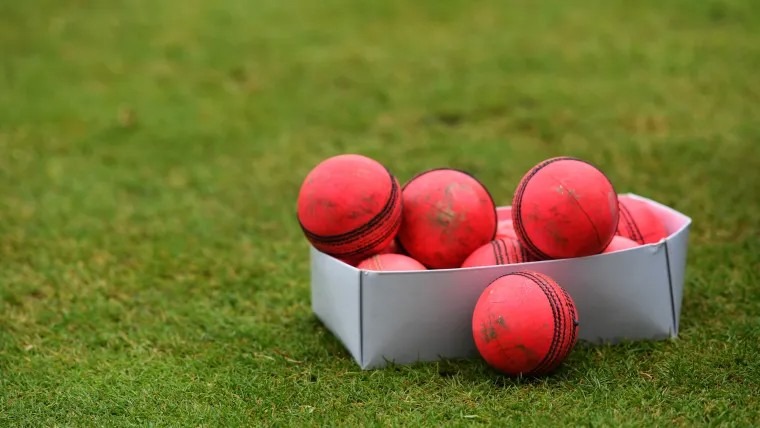
Test cricket has traditionally been played with a red ball during daylight hours. However, the introduction of pink-ball cricket brought a new dimension to the longest format, allowing matches to continue into the evening under floodlights.
A pink ball Test is usually played as a day-night match, giving spectators more opportunities to watch cricket after work. Its special surface finish also creates different playing conditions, particularly during twilight when visibility and ball movement can challenge batters.
The debate over pink-ball cricket has grown following the ICC’s October 2026 provision allowing pink balls in daytime Tests by mutual agreement. From India’s first pink-ball match in 2016 to the famous 36 all out at Adelaide, here is everything you need to know about its history, rules, statistics and differences from the traditional red ball.
What Is a Pink Ball Test in Cricket?
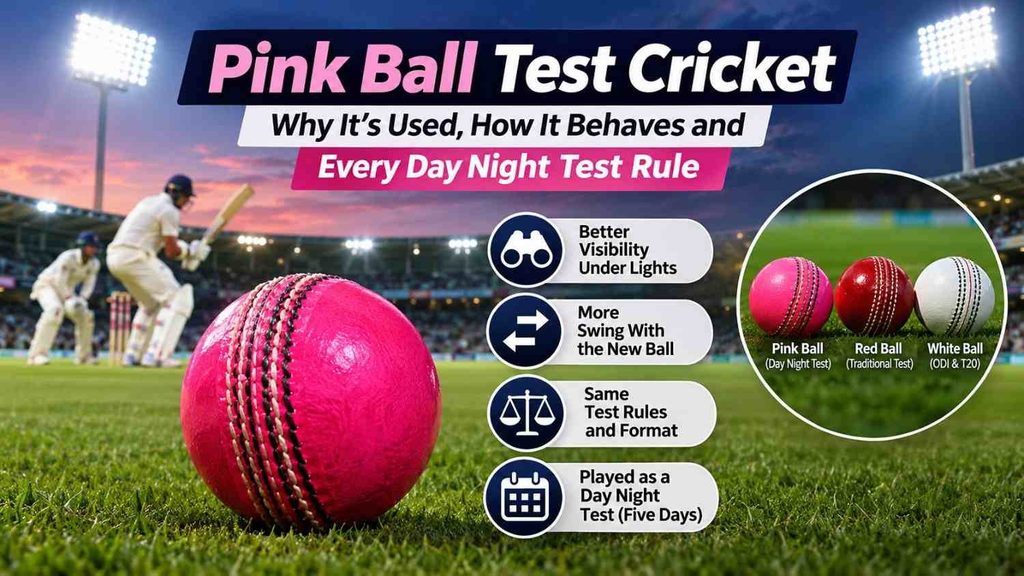
A pink ball Test is a Test cricket match played with a pink-coloured ball instead of the traditional red ball.
Most pink ball Tests have been organised as day-night matches. They usually begin in the afternoon, with the final session played under stadium floodlights.
The main objective is to make Test cricket more convenient for spectators. Evening sessions allow people to watch matches after work and provide broadcasters with more opportunities to reach viewers.
The first men’s day-night Test was played between Australia and New Zealand at the Adelaide Oval from November 27 to December 1, 2015. Australia won the historic match by three wickets.
Although pink-ball cricket is most commonly associated with day-night Tests, an ICC playing-conditions trial introduced in October 2026 also allows pink balls to be used in daytime Tests under specific conditions.
Important Milestones in Pink Ball Cricket
| Year | Event |
| 2008 | Pink-ball trial in a women’s exhibition match between Queensland and Western Australia |
| 2009 | First international match using a pink ball: Australia Women vs England Women |
| October 2012 | ICC approved day-night Test matches under revised playing conditions |
| 2013–14 | Three pink-ball day-night matches were played in Australia’s Sheffield Shield |
| 2015 | First men’s day-night Test between Australia and New Zealand at Adelaide Oval |
| June 2016 | India’s first pink-ball match took place at Eden Gardens, Kolkata |
| August 2016 | Duleep Trophy became India’s first national first-class competition to use pink balls |
| 2019 | India played its first pink-ball Test against Bangladesh at Eden Gardens |
| 2020 | Bad-light interruptions in England vs Pakistan renewed the debate about pink-ball use |
| 2026 | ICC introduced a trial provision allowing pink balls in daytime Tests by mutual agreement |
India’s First Pink Ball Match: 2016
India’s first pink-ball match took place at Eden Gardens in Kolkata on June 18, 2016. It was the Cricket Association of Bengal’s Super League final between Mohun Bagan and Bhowanipore Club.
The Duleep Trophy followed in August 2016 and became the first national first-class competition in India to use pink balls.
India’s first pink-ball Test came later, against Bangladesh at Eden Gardens on November 22, 2019. India won the match by an innings and 46 runs.
Why Is a Pink Ball Used in Test Cricket?
The main reason for using a pink ball is visibility during day-night cricket.
A traditional red ball is designed primarily for daylight conditions. It can become difficult to follow under artificial lights, while a white ball is designed for limited-overs cricket rather than the longer playing periods of Test cricket.
Cricket authorities therefore needed a ball that could provide useful visibility during daylight, twilight and evening sessions.
Here are the main reasons pink was selected.
1. Designed for Daylight and Floodlight Conditions
The pink ball was developed to make cricket easier to follow during day-night matches. Its bright colour and surface finish were intended to provide useful contrast in natural light and under stadium floodlights.
However, visibility is not equally good in every condition. Research has found that a pink ball can become difficult to track during twilight, particularly against the crowd and sky. An older ball may also become harder to distinguish from certain backgrounds.
Therefore, the pink ball is designed for day-night cricket, but it does not eliminate every visibility problem.
2. White Balls Are Designed for Limited-Overs Cricket
White balls are primarily used in One Day Internationals and T20 matches.
Their surface and visibility characteristics are designed around limited-overs cricket. Test cricket requires a ball suitable for much longer periods of play, making the pink ball a more practical option for day-night Test matches.
3. Better Opportunities for Television Coverage
The pink colour provides useful contrast in many lighting conditions, helping television cameras capture the ball’s movement.
However, camera visibility also depends on lighting, background and the ball’s condition. Twilight can still create challenges for television viewers and players.
4. Supports Evening Test Cricket
Day-night scheduling allows more people to watch Test cricket after work or school. It can also help attract larger evening crowds and create more convenient broadcasting schedules.
The pink ball therefore supports efforts to make Test cricket more accessible without changing its traditional five-day structure.
How Is a Pink Cricket Ball Made?
A pink cricket ball has a construction similar to a conventional red cricket ball. Its basic structure includes a cork core, tightly wound yarn and a leather outer covering.
The main differences are associated with the leather’s colour, surface treatment and finishing process.
Manufacturers apply pink colouring and additional surface treatments to produce the required appearance and visibility. Pink balls also receive extra coats of lacquer to help preserve their colour and shine.
According to manufacturing explanations reported by SG, the additional pigment and lacquer layers help the pink ball retain its shine for longer than a traditional red ball.
This longer-lasting shine can influence how the ball behaves in the air. It helps explain why pink balls can offer swing for a longer period under suitable conditions. However, the amount of swing still depends on the manufacturer, weather, pitch and ball condition.
Companies such as Kookaburra, SG and Dukes may use different construction methods, surface finishes and seam designs. These differences can influence how individual balls behave during a match.
How Does a Pink Ball Behave in Test Cricket?
The pink ball can behave differently from a red ball, particularly under changing lighting conditions and as the ball becomes older.
However, not every pink ball behaves identically. The manufacturer, pitch, weather, surface condition, seam design and stage of the match all influence its performance.
1. Swing With the New Ball
Pink balls can offer movement through the air when new, but the amount of swing is not necessarily greater than that of a red ball.
The additional lacquer helps preserve the ball’s shine, which can support swing under suitable conditions.
However, the ball’s manufacturer, surface finish, seam design, atmospheric conditions and bowling technique all influence swing. There is no universal rule that a pink ball always swings more.
2. The Twilight Challenge
Twilight is one of the most challenging periods in a pink ball Test.
During this phase, daylight fades while stadium floodlights become more important. The changing background and lighting can make it harder for batters to judge the ball’s line, length and speed.
Research published in the Journal of Science and Medicine in Sport in 2024 examined the visibility of red, white and pink cricket balls under different lighting conditions.
The research found that pink-ball visibility can become challenging during dusk. A new pink ball may have poor contrast against the crowd, while an older pink ball may become difficult to distinguish from the pitch and grass. Pink and white balls can also have low contrast against the sky at dusk.
These findings show that pink-ball visibility depends on the lighting, background and condition of the ball.
3. Seam Movement
The seam can help fast bowlers generate movement after the ball pitches.
Its design, visibility and condition vary between manufacturers. A well-maintained seam, combined with suitable pitch and weather conditions, can help bowlers create challenging deliveries.
The dark or contrasting seam also provides a visible reference for batters attempting to judge the ball’s rotation and direction.
4. Reverse Swing and Spin
The behaviour of an older pink ball depends on its surface condition and how it wears during the match.
The additional lacquer can make it harder to maintain the rough-and-shiny condition traditionally used to generate reverse swing. However, the actual result depends on the ball’s construction, wear and playing conditions.
Spin bowling also depends on the pitch, ball condition, bowler’s technique and the amount of turn available.
There is no universal rule that pink balls are less effective for spinners. A skilled spinner can remain effective when the conditions support turn, drift and changes of pace.
Pink Ball vs Red Ball vs White Ball: Key Differences
Each cricket ball has a specific purpose. Colour, surface finish and visibility requirements determine where it is used.
| Feature | Pink Ball | Red Ball | White Ball |
| Main use | Day-night Tests and approved daytime Test trials | Traditional Test cricket | ODI and T20 cricket |
| Visibility | Designed for daylight and floodlights; twilight can be challenging | Best suited to daylight conditions | Designed for limited-overs conditions, including matches under lights |
| Surface finish | Pink colouring and additional manufacturer-specific finishing | Traditional red leather finish | White surface finish |
| Swing | Can retain shine and offer swing under suitable conditions | Depends on conditions and ball age | Can offer early swing |
| Seam visibility | Contrasting seam, depending on manufacturer | Contrasting seam | Contrasting seam |
| Match duration | Test match | Test match | Limited-overs match |
| Main challenge | Visibility during twilight and as the ball ages | Visibility under artificial lights | Maintaining suitable condition during limited-overs play |
Important: Differences in swing, visibility and durability are not absolute. They depend on the manufacturer, playing conditions, ball age and match environment.
The 2020 Bad-Light Debate: How the Pink Ball Became a Bigger Talking Point
The debate about using pink balls in daytime Test cricket gained attention after the second Test between England and Pakistan at Southampton in August 2020.
Only 134.3 overs were bowled across the five days because of rain and repeated bad-light interruptions. It became the shortest Test match on English soil in 33 years in terms of balls bowled.
England captain Joe Root called for the playing conditions to be reviewed, arguing that the problem needed attention beyond the decisions made by the on-field umpires.
The ICC Cricket Committee was due to discuss possible solutions, including greater use of pink balls and allowing more play under floodlights. The committee was chaired by former India captain Anil Kumble.
The discussion produced different opinions.
Joe Root Wanted the Bad-Light Rules Reviewed
Root expressed frustration about the amount of cricket lost during the England-Pakistan Test. He believed the rules needed to be reviewed to prevent similar situations in future matches.
The debate was not simply about changing the ball. It also involved starting times, floodlight standards and the way umpires assess bad light.
Shane Warne Supported Pink Balls in All Tests
Australian spin legend Shane Warne supported a more extensive use of pink balls.
In December 2020, he argued that pink balls should be considered for all Test matches, including traditional daytime games, rather than being restricted to day-night fixtures.
Warne believed the pink ball offered better visibility and could provide more assistance to bowlers.
Waqar Younis Warned Against a Universal Change
Pakistan bowling coach Waqar Younis offered a different perspective.
He warned that using pink balls in every Test was not as straightforward as it might appear. He specifically questioned how a pink Dukes ball would behave in English conditions.
Waqar said: “I don’t yet know how a Dukes pink ball will behave in this country.”
He also warned that overcast conditions combined with floodlights could make the ball move excessively, potentially changing the balance between bat and ball.
This concern remains relevant because Kookaburra, SG and Dukes balls can have different characteristics. A change that works in one country may not produce the same results in another.
Pink Ball Test Cricket Statistics
Pink-ball Tests have produced a strong record of decisive results and have generally been more challenging for batters than traditional red-ball matches.
A late-2025 statistical analysis reported the following figures:
| Statistic | Figure |
| Men’s day-night Tests played before the 2025 Gabba Test | 24 |
| Drawn matches among those 24 Tests | 0 |
| Average bowling average in day-night Tests | 25.41 |
| Average bowling average for pace bowlers | 23.77 |
The lower bowling averages indicate that bowlers have generally enjoyed greater success in day-night Tests than in traditional Test cricket.
However, these statistics do not prove that the pink ball alone causes the difference. Conditions, pitches, venues, team strengths and the timing of sessions also influence match results.
Australia has been particularly successful in the format, while several other countries have hosted comparatively few day-night Tests.
India’s Famous Pink Ball Test: 36 All Out Against Australia
One of the most memorable moments in pink-ball Test history came during India’s tour of Australia in December 2020.
India faced Australia in a day-night Test at Adelaide Oval. After taking a first-innings lead, India suffered a dramatic batting collapse in their second innings.
The Indian team was bowled out for just 36 runs, its lowest total in Test cricket history.
Australia won the match by eight wickets.
The collapse demonstrated how challenging pink-ball conditions could become for batters, particularly when fast bowlers found movement and exploited weaknesses in technique.
The match remains one of the most widely remembered examples of the difficulties associated with pink-ball Test cricket.
Could India and Australia Play a Pink Ball Test at Guwahati?
The ICC’s October 2026 rule change has created a new possibility for traditional daytime Tests.
Reporting following the announcement identified an upcoming Border-Gavaskar Trophy Test between India and Australia at Guwahati as a possible candidate for pink-ball use.
The city’s early sunset could make the new provision relevant by helping reduce the risk of losing playing time because of fading light.
However, the Guwahati Test has not been confirmed as a pink-ball match. The reported possibility is not an official match announcement. Under the ICC provision, both teams must agree to use the pink ball before the Test begins.
The development gives the new rule a direct India-Australia context and could provide an important test of the ICC’s daytime pink-ball trial.
What Are the Rules of a Pink Ball Day-Night Test?
A pink ball Test follows the same basic Laws of Cricket and standard Test match structure as a traditional red-ball Test.
The main differences relate to the ball colour, scheduled playing hours and lighting arrangements.
Here are the important rules and playing conditions.
1. Five-Day Match Format
A pink ball Test is generally scheduled for five days, just like a traditional Test match.
Each team has two innings, and the usual Test cricket rules regarding batting, bowling, follow-ons and match results apply.
2. Afternoon Start and Evening Finish
Day-night Tests usually begin in the afternoon and continue into the evening.
The exact starting time, session timings and intervals depend on the venue and local playing conditions.
3. Use of the Pink Ball Throughout the Match
In a pink ball Test, the pink ball is used throughout the match.
Teams cannot simply switch to a red ball when evening conditions become difficult.
If the ball becomes damaged or unsuitable for play, the umpires can replace it according to the applicable playing conditions. The replacement must comply with the relevant rules; the team cannot use a ball of a different colour simply because it prefers one.
4. New Ball After 80 Overs
The standard Test cricket new-ball provision applies to pink-ball Tests.
The fielding captain may request a new ball once at least 80 overs, excluding part overs, have been bowled with the existing ball.
The same provision applies to red-ball Test cricket under the standard ICC Test playing conditions.
5. Floodlights Are Used
Stadium floodlights become essential as natural daylight fades.
The lights help players follow the ball during evening sessions, although twilight can still create visibility problems.
6. New ICC Rule for Pink Balls in Daytime Tests
The ICC introduced an important change to its Test playing conditions on October 1, 2026.
Under the new provision, pink balls may also be used in daytime Test matches as a trial when both teams agree. The change is intended to help reduce the loss of playing time caused by bad light.
There are important conditions:
- Both teams must agree to use the pink ball before the start of the Test.
- Once the match starts, the decision cannot be changed.
- The pink ball must be used for the duration of the match under the agreed arrangement.
- Teams cannot switch from a red ball to a pink ball after the match has started.
- The new playing conditions apply to international series starting on or after October 1, 2026.
- Ongoing series continue under their previous regulations.
This is a significant development because pink-ball cricket is no longer limited to conventional day-night scheduling under the updated playing conditions.
However, this is a trial provision and does not mean that all traditional red-ball daytime Tests have been replaced.
Advantages and Disadvantages of Pink Ball Test Cricket
Pink ball cricket has created new opportunities for Test cricket, but it also brings challenges for players and spectators.
| Advantages | Disadvantages |
| Designed for visibility during day-night matches | Visibility can become difficult during twilight |
| Makes evening Test sessions possible | Batters need to adjust to changing lighting |
| Can retain shine for longer | Swing characteristics vary between manufacturers and conditions |
| Improves evening viewing opportunities | The ball can be difficult to distinguish against certain backgrounds |
| Adds tactical challenges for captains | Ball behaviour changes with age and surface condition |
The biggest advantage is that pink ball cricket makes evening Test sessions possible and gives spectators more convenient viewing opportunities.
However, players must adapt to changing light conditions and the characteristics of the ball used in the match.
Why Do Batters Struggle Against the Pink Ball?
Batting against a pink ball can be difficult, especially during the evening session.
There are several reasons:
- Changing light: The transition from daylight to floodlights can make it harder to judge the ball.
- Swing movement: A new pink ball can move through the air under suitable conditions, particularly while its shine is intact.
- Seam movement: Fast bowlers can use the seam to trouble batters after pitching.
- Visibility: The ball can become difficult to track against certain backgrounds during twilight.
- Ball condition: The surface and visibility characteristics can change as the ball becomes older.
- Timing: Batters must adjust their footwork and shot selection to different bowling and lighting conditions.
These challenges explain why teams often pay special attention to the twilight session when planning their batting and bowling strategies.
Conclusion
Pink ball Test cricket is an important development in the history of the longest format. It allows matches to be played under floodlights while making evening sessions more accessible to spectators.
Its history includes the first men’s day-night Test in 2015, India’s first pink-ball match in 2016, the famous 36 all out at Adelaide in 2020 and the ICC’s new daytime trial provision in October 2026.
The pink ball also creates different challenges for batters and bowlers. Its surface finish, seam design, visibility and behaviour under changing lighting conditions make it an interesting part of modern Test cricket.
The ICC’s October 2026 provision allowing pink balls in daytime Tests by mutual agreement could expand the role of the pink ball beyond conventional day-night scheduling.
However, the pink ball does not always provide better visibility or more swing than a red ball. Its performance depends on the manufacturer, ball age, pitch, weather and lighting conditions.
Ultimately, pink ball cricket combines the traditional format of Test cricket with a modern approach to scheduling and spectator engagement.
Frequently Asked Questions About Pink Ball Test Cricket
A pink ball is used in day-night Test cricket because it was developed to provide useful visibility during daylight and under floodlights. However, visibility can still become challenging during twilight and against certain backgrounds.
The first pink-ball trial took place in 2008 in a women’s exhibition match between Queensland and Western Australia. The first international match using a pink ball was played between Australia Women and England Women in 2009.
The first men’s day-night Test was played between Australia and New Zealand at the Adelaide Oval from November 27 to December 1, 2015. Australia won the match by three wickets.
Not necessarily. A pink ball can retain its shine for longer and offer early swing, but the amount of movement depends on the manufacturer, surface finish, seam design, weather, pitch and bowling conditions. There is no universal rule that a pink ball always swings more than a red ball.
Twilight creates rapidly changing lighting conditions as daylight fades and floodlights take over. The pink ball can become difficult to distinguish against the crowd or sky, making it harder for batters to judge its movement.