
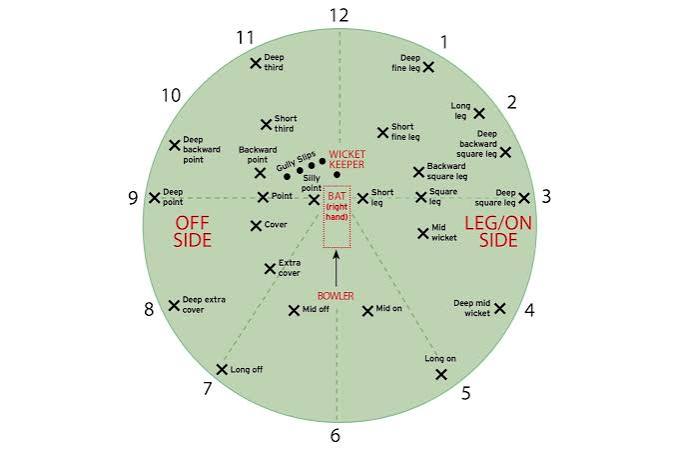
Cricket is a game of skill, strategy and teamwork. Every fielder has a specific position, from the wicketkeeper and slips to point, cover and deep midwicket. Each position helps the team stop runs, catch the ball and create wicket-taking opportunities.
Understanding fielding positions in cricket becomes easier when you know where each fielder stands. This guide explains the major positions, their responsibilities and a simple field map using clock-face directions from a right-handed batter’s perspective.
You will also learn the difference between the off side and leg side, fielding restrictions in ODI and T20 cricket, and how captains adjust their field placements according to match situations.
What Are Fielding Positions in Cricket?
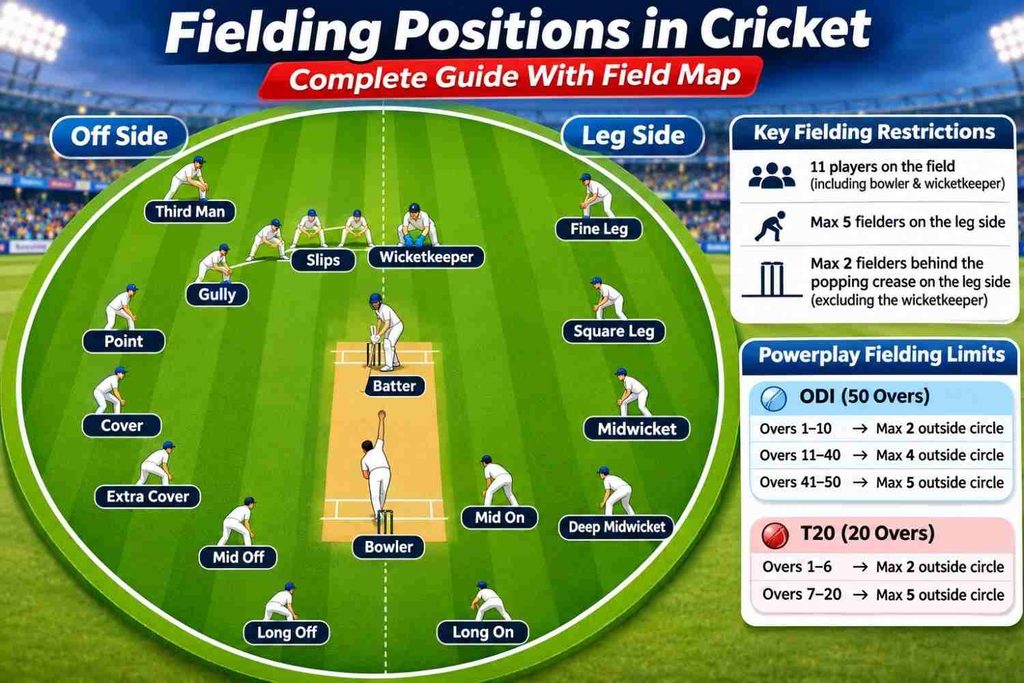
Fielding positions in cricket refer to the specific areas where players stand while their team is bowling. The captain decides where to place each fielder to stop runs, catch the ball and create opportunities to dismiss batters.
A cricket team has 11 players on the field, including the bowler and wicketkeeper. The remaining nine players are positioned around the ground according to the captain’s fielding plan.
There is no fixed number of named fielding positions. Captains can place fielders in different areas depending on the match situation. However, several traditional positions have standard names and responsibilities.
For example:
- Slip: Catches edges behind the batter.
- Gully: Stops and catches thick edges behind square on the off side.
- Point: Protects the square off side.
- Cover: Stops cover drives on the off side.
- Mid-off: Protects straight drives on the off side.
- Midwicket: Covers attacking shots on the leg side.
- Fine leg: Stops glances, flicks and deflections behind square on the leg side.
- Third man: Protects the area behind square on the off side.
Understanding the Off Side and Leg Side in Cricket
Before learning individual fielding positions, it is important to understand two basic areas of a cricket ground: the off side and the leg side.
These areas are identified according to the batter’s stance and orientation.
1. Off Side
The off side is the side of the field associated with the batter’s off side. For a right-handed batter facing the bowler, it is generally on the batter’s right.
Common off-side fielding positions include:
- Slip
- Gully
- Point
- Backward point
- Cover
- Extra cover
- Mid-off
- Third man
2. Leg Side
The leg side, also called the on side, is the opposite side associated with the batter’s legs.
For a right-handed batter facing the bowler, it is generally on the batter’s left.
Common leg-side fielding positions include:
- Fine leg
- Square leg
- Midwicket
- Mid-on
- Leg slip
- Short leg
- Deep square leg
- Long-on
Important: When a left-handed batter takes strike, the physical off-side and leg-side areas reverse. The field map in this article uses a right-handed batter’s perspective.
Fielding Positions in Cricket With Field Map
The cricket field is divided into different areas around the batter. The following simplified field map uses clock-face directions to help readers understand where the major fielders stand.
Cricket Field Map: Clock-Face Positions
Imagine the batter standing at the centre of a clock and facing the bowler. For a right-handed batter, the off side is on the right and the leg side is on the left.
| Fielding Position | Approximate Clock Direction | General Area |
| Third man | 4 o’clock | Behind square on the off side |
| Point | 3 o’clock | Square on the off side |
| Cover | 2 o’clock | Forward of point |
| Mid-off | 1 o’clock | Straight on the off side |
| Mid-on | 11 o’clock | Straight on the leg side |
| Midwicket | 10 o’clock | Between square leg and mid-on |
| Square leg | 9 o’clock | Square on the leg side |
| Fine leg | 8 o’clock | Behind square on the leg side |
These clock positions are approximate visual guides, not fixed official coordinates. Actual placements vary according to the bowler, batter and match situation.
Central Fielding Positions
| Position | General Area |
| Wicketkeeper | Behind the stumps |
| Batter | At the striker’s crease |
| Bowler | At the bowling end |
| Mid-off | More or less straight on the off side |
| Mid-on | More or less straight on the leg side |
Off-Side Fielding Positions
| Position | General Area |
| Third man | Behind square on the off side, usually near the boundary |
| Slips | Behind the batter, beside the wicketkeeper |
| Gully | Between the slip cordon and point |
| Point | Square on the off side |
| Backward point | Behind square on the off side |
| Cover | Forward of point on the off side |
| Extra cover | Between cover and mid-off |
| Mid-off | More or less straight on the off side |
Leg-Side Fielding Positions
| Position | General Area |
| Fine leg | Behind square on the leg side |
| Square leg | Square on the leg side |
| Midwicket | Between square leg and mid-on |
| Mid-on | More or less straight on the leg side |
| Deep midwicket | Near the boundary between long-on and deep square leg |
| Deep square leg | Near the boundary square on the leg side |
| Deep fine leg | Near the boundary behind square on the leg side |
| Long-on | Near the boundary straight on the leg side |
This is a simplified reference, not a precise geographical field layout. Actual field placements vary with the batter, bowler and match situation.
All Major Fielding Positions in Cricket Explained
Source Image: sportsboom
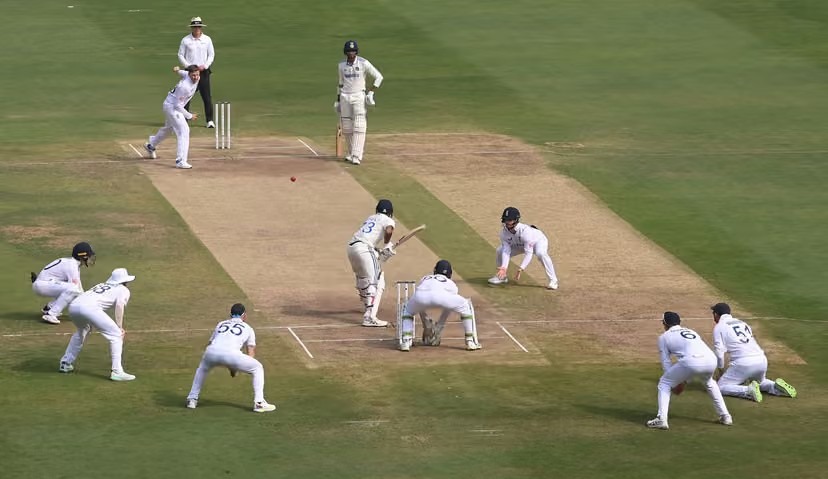
Cricket fielding positions can be grouped into three useful explanatory categories: close catching positions, inner-circle positions and boundary positions.
These are not fixed official classifications. A fielder can move closer to the batter or farther towards the boundary depending on the captain’s strategy and match situation. For example, third man can be placed as short third man or deep third man.
1. Close Catching Positions
These fielders stand close to the batter. Their primary responsibility is to catch edges, defensive shots and mistimed strokes.
Wicketkeeper
The wicketkeeper stands directly behind the stumps. The player wears gloves and protective equipment and tries to catch deliveries, stop byes and complete stumpings.
Slip
Slip fielders stand beside the wicketkeeper on the off side. First slip is closest to the keeper, followed by second slip and third slip. They catch edges produced by fast bowlers.
Gully
Gully stands between the slip cordon and point, slightly wider and squarer than the slips. It is used to catch thick edges and mistimed shots that travel behind square on the off side.
Silly Point
Silly point stands very close to the batter on the off side. This position is commonly used against spin bowling to catch defensive shots.
Short Leg
Short leg stands close to the batter on the leg side. The fielder looks for catches from bat-and-pad deflections, especially against spin.
Other close catching positions include leg slip, leg gully, silly mid-off and silly mid-on.
2. Inner Circle Fielding Positions
These positions are generally used to stop singles, prevent boundaries and create run-out opportunities.
| Fielding Position | Location and Responsibility |
| Point | Square on the off side; stops cuts and square shots |
| Backward point | Slightly behind point; covers late cuts |
| Cover | Forward of point on the off side; stops cover drives |
| Extra cover | Between cover and mid-off; protects attacking drives |
| Mid-off | More or less straight on the off side; stops straight drives |
| Mid-on | More or less straight on the leg side; stops straight drives |
| Midwicket | Between mid-on and square leg; protects leg-side shots |
| Square leg | Square on the leg side; stops pulls and sweeps |
| Short fine leg | A closer position behind square on the leg side |
| Short third man | A closer position behind square on the off side |
3. Boundary Fielding Positions
Boundary fielders stand close to the rope to prevent fours and sixes. They also attempt to catch lofted shots.
| Fielding Position | Location and Responsibility |
| Third man | Behind square on the off side, generally near the boundary; protects against edges and late cuts |
| Fine leg | Behind square on the leg side; stops glances and fine deflections |
| Deep point | Near the boundary square on the off side |
| Deep cover | Near the boundary in the cover region on the off side; protects against lofted cover drives |
| Sweeper cover | Deep on the off side, usually covering a wide area between point and cover |
| Long-off | Near the boundary, straight on the off side |
| Long-on | Near the boundary, straight on the leg side |
| Deep midwicket | Near the boundary between long-on and deep square leg |
| Deep square leg | Near the boundary square on the leg side |
| Deep fine leg | The boundary version of fine leg, behind square on the leg side |
Deep fine leg and long leg: These names are often used for overlapping areas behind square on the leg side. Rather than treating them as two clearly separate fixed positions, it is more accurate to describe long leg as a variation of a deep fine-leg placement.
Some other commonly used fielding terms include cow corner, deep backward point and deep extra cover.
What is cow corner?
Cow corner is an informal name for a deep leg-side position between deep midwicket and long-on. It is often used to protect against powerful shots hit towards that area.
What Do Fine, Square, Short, Deep and Silly Mean in Cricket?
These words help explain the exact location of a fielder in relation to the batter, pitch and boundary.
| Term | Meaning | Example |
| Fine | Closer to the line of the pitch than a square position | Fine leg |
| Square | Near a line perpendicular to the pitch | Square leg |
| Short | Closer to the batter | Short leg |
| Deep | Closer to the boundary | Deep cover |
| Silly | Extremely close to the batter | Silly point |
| Long | Near the boundary in a relatively straight position | Long-on |
| Backward | Behind the batter’s popping crease | Backward point |
| Forward | In front of the batter’s popping crease | Forward short leg |
For example, deep square leg stands near the boundary on the leg side, while short leg stands close to the batter on the same side.
How Do Fielding Positions Change in Different Cricket Formats?
Fielding positions change according to the format of cricket, the number of overs remaining and the batter’s playing style.
Test Cricket
Test cricket allows captains to use a range of attacking field placements, including close catchers and slips. The fielding plan can change according to the bowler, batter, pitch and match situation.
Common field settings include:
- Three or four slips for fast bowlers.
- Gully to catch thick edges.
- Short leg and silly point against spinners.
- Close catchers around the batter.
- Mid-off and mid-on to control straight shots.
One Day International Cricket
ODI cricket requires a balance between attacking and defensive field placements. Captains must follow powerplay and outside-circle restrictions.
In a standard 50-over men’s ODI, the outside-circle limits are:
- Overs 1–10: Maximum two fielders outside the 30-yard circle.
- Overs 11–40: Maximum four fielders outside the 30-yard circle.
- Overs 41–50: Maximum five fielders outside the 30-yard circle.
Captains often use point, cover, midwicket, fine leg and third man to control scoring opportunities while following these restrictions.
T20 Cricket
T20 cricket focuses heavily on boundary protection and saving runs. Captains regularly move fielders according to the batter’s preferred scoring areas.
In a standard 20-over men’s T20 international:
- Overs 1–6: Maximum two fielders outside the 30-yard circle during the powerplay.
- Overs 7–20: Maximum five fielders outside the 30-yard circle.
Common T20 boundary positions include:
- Deep midwicket
- Long-on
- Long-off
- Deep square leg
- Deep cover
- Fine leg
- Third man
The exact fielding restrictions can differ in domestic and franchise competitions.
Important Fielding Restrictions in Cricket
Fielding positions are not completely unrestricted. The Laws of Cricket and competition-specific playing conditions determine where fielders can stand during a delivery.
Under clause 28.7 of the ICC Men’s ODI and T20I Playing Conditions, important restrictions include:
- Maximum 11 players: Only 11 players from the fielding team can be on the field, including the bowler and wicketkeeper.
- Maximum five leg-side fielders: At the moment of delivery, no more than five fielders can be positioned on the leg side.
- Maximum two behind the popping crease: At the moment of delivery, no more than two fielders, excluding the wicketkeeper, can be behind the popping crease on the leg side.
- Pitch encroachment: Subject to the playing conditions, fielders other than the bowler must not have any part of their person grounded on or extended over the pitch while the ball is in play before the ball contacts the striker’s bat or person or passes the bat.
- Outside-circle restrictions: ODI and T20 cricket have additional restrictions on the number of fielders allowed outside the 30-yard circle.
These references describe the men’s international playing conditions applicable as of October 2026. Competition-specific conditions should always be checked separately.
ODI Powerplay Fielding Restrictions
In a standard 50-over men’s ODI, fielding restrictions are divided into three powerplay phases.
| Powerplay | Overs | Maximum Fielders Outside the 30-Yard Circle |
| Powerplay 1 | 1–10 | 2 |
| Powerplay 2 | 11–40 | 4 |
| Powerplay 3 | 41–50 | 5 |
T20 Powerplay Fielding Restrictions
In a standard 20-over men’s T20 international, fielding restrictions are divided into two phases.
| Phase | Overs | Maximum Fielders Outside the 30-Yard Circle |
| Powerplay | 1–6 | 2 |
| Non-powerplay | 7–20 | 5 |
These restrictions encourage attacking field placements during the powerplay and allow more defensive boundary protection during the remaining overs.
The figures above describe standard, uninterrupted men’s international innings. Shortened innings have adjusted restrictions, and domestic or franchise competitions may use different playing conditions.
Did ODI Cricket Once Require Catching Fielders in the First 10 Overs?
Yes. Before the 2015 ODI fielding-restriction changes, teams were required to keep at least two fielders in catching positions during the first 10 overs.
The 2015 changes removed this mandatory catching-position requirement and the batting powerplay. They also changed the outside-circle limit in the final 10 overs from four fielders to five.
This is an important example of how fielding rules have evolved to change the balance between batting and bowling.
Do Women’s Cricket Fielding Restrictions Differ?
Yes. Women’s international cricket has different fielding-circle dimensions and outside-circle limits from the men’s game.
In standard women’s ODIs and T20Is, the fielding circle measures 25.15 yards rather than 30 yards. During non-powerplay overs, a maximum of four fielders can be outside the circle, compared with five in the corresponding men’s international formats.
For more details about ground dimensions, see our guide to cricket ground size in feet.
Conclusion
Understanding all fielding positions in cricket makes it easier to follow the game’s tactical side. Each position has a specific purpose, from catching edges at slip to stopping boundaries at deep midwicket.
The clock-face field map helps beginners visualise where important fielders stand, while the position descriptions explain their responsibilities. Test cricket often uses attacking close catchers, whereas ODI and T20 cricket require greater attention to boundary protection and powerplay restrictions.
Learning the field map and the responsibilities of each position is a useful starting point for every cricket fan and aspiring player.
Frequently Asked Questions About Fielding Positions in Cricket
There is no fixed number of fielding positions in cricket. However, around 30 or more commonly recognised names are used to describe different areas of the field. Captains can also create variations by moving fielders closer to or farther from the batter.
Some commonly used fielding positions are wicketkeeper, slip, gully, point, cover, extra cover, mid-off, mid-on, midwicket, square leg and fine leg. These are examples of recognised positions, not a compulsory set of 11 positions. The actual fielding combination depends on the match situation.
The off side and leg side are identified according to the batter’s stance. For a right-handed batter facing the bowler, the off side is generally on the batter’s right and the leg side is on the batter’s left. These physical sides reverse for a left-handed batter.
Point stands square of the wicket on the off side, while cover stands further forward between point and mid-off. Point mainly protects against cut shots, whereas cover protects against drives.
Silly point, silly mid-off, silly mid-on and short leg are among the closest fielding positions to the batter. These positions are mainly used to catch defensive shots and bat-and-pad deflections, particularly against spin bowling.